Source: In Thee Is Gladness
In Thee Is Gladness
23 Saturday Jan 2016
Posted in Uncategorized

23 Saturday Jan 2016
Posted in Uncategorized
Source: In Thee Is Gladness
23 Saturday Jan 2016
Posted in Uncategorized
In thee is gladness, amid all sadness, Jesus, sunshine of my heart.
By thee are given the gifts of heaven,
thou the true Redeemer art.
Our souls thou makest, our bonds thou breakest;
who trusts thee surely hath built securely,
and stands forever. Hallelujah!
Our hearts are pining to see thy shining;
dying or living, to thee are cleaving;
naught can us sever. Hallelujah!
If God be ours, we fear no powers, nor of earth nor sin nor death.
God sees and blesses in worst distresses,
and can change them with a breath.
Wherefore the story tell of God’s glory
with heart and voices; all heaven rejoices,
singing forever; Hallelujah!
We shout for gladness, triumph o’er sadness,
love thee and praise thee,and still shall raise thee
glad hymns forever: Hallelujah!
I’ve always liked this hymn – it seems like a happy thing. A tune that dances along; a title that implies something good. It’s fun to sing. It’s fun to play. The words, written in 1594 by Johann Lindemann and translated by Catherine Winkworth in 1858, were set to one of Giovanni Gastoldi’s 1591 madrigals. One of the characteristics of late 16th century madrigals was to let the music express the words. This tune certainly does express the gladness, praise, singing and hallelujahs found in these words.
And yet, these words do not reflect gladness in isolation. It exists amid sadness, broken bonds, death, distresses and pining hearts. I think this is important. I often wonder at our tendency to assume there are easy solutions to emotional and mental challenges. Believe this and all will be well. Look on the bright side. Count your blessings. Nothing will be a greater burden than you can bear. Maybe on some level these platitudes are true, but often they fill me with a sense of unease. They imply that there is no place for sadness; no place for looking at the darkness that exists in all of our lives. And for those that regularly live in this darkness, platitudes are a heavy burden.
I am learning to treasure the coexistence of both sadness and gladness as described in the words of this hymn. There is balance in accepting both. We share this experience – the good and the bad. We need to understand that our culture’s pursuit of happiness is a flawed endeavour.
These particular words refer to God as a source of gladness that carries us through all the darkness, and for many that is the case. But there are other sources as well. Perhaps it is family and friends, or nature, or art or music. Something that reminds us that while life is complicated, there is gladness to be found. For those that find themselves deep in the depths of sadness, I hope we can exhibit gladness as we help carry, counsel, treat and encourage. Gladness that doesn’t judge, but that simply provides a picture of the wholeness available to us; of the possibility of balance. Gladness that allows us to sing Hallelujah! despite the spaces where we live. Gladness amid all the sadness. Hallelujah.
25 Friday Dec 2015
Posted in Uncategorized
Source: Away In A Manger
24 Thursday Dec 2015
Posted in Uncategorized
Away in a manger, no crib for a bed,
The little Lord Jesus laid down his sweet head.
The stars in the bright sky looked down where he lay,
The little Lord Jesus asleep in the hay.
The cattle are lowing, the baby awakes,
But little Lord Jesus no crying he makes.
I love Thee, Lord Jesus, look down from the sky
And stay by my cradle ’til morning is nigh.
Be near me, Lord Jesus, I ask Thee to stay
Close by me forever, and love me, I pray.
Bless all the dear children in thy tender care,
And take us to heaven, to live with Thee there.
05 Saturday Dec 2015
Posted in Uncategorized
Source: Come, Thou Long Expected Jesus
05 Saturday Dec 2015
Posted in Uncategorized
It is a strange time. It seems we are inundated with news of tragedies and horrors – every week, every day. It seems we are convinced that times are worse than ever. Danger is ever lurking, fear is a staple. Maybe the danger is real, maybe not. But as I consider a number of events that have occurred in the past month or so, I am struck by the responses. Filled with both joy and concern.
Come, thou long expected Jesus,
born to set thy people free;
from our fears and sins release us,
let us find our rest in thee.
Israel’s strength and consolation,
hope of all the earth thou art;
dear desire of every nation,
joy of every longing heart.
It is the season of Advent, and in my tradition that means we are waiting and preparing for the arrival of the birth of Christ. For me, the example of Jesus represents the ideal of a gospel of peace. Not the gospel in the sense of some infallible religious doctrine or practice that can only be observed by the few, but a gospel in the sense of a truth that is of utmost importance. Peace is worth preparing for. Peace is about stepping away from the conflicts between us and finding ways to coexist in tranquillity and respect. Peace is desired by most of us, probably all of us. Even for those who appear to want something else, one has to consider why they are so filled with pain that they would choose hate as an alternative to whatever they have experienced.
When Charles Wesley wrote these words in 1877, he originally did so as a response to what he saw as an inexcusable situation for orphans in England at the time. The story goes that he was disturbed by the class divisions in society and, among other things, the resulting neglect of so many children. If I read the words of the second verse with this in mind, they take on a whole new meaning. These children needed to be rescued. They needed to be raised up to a place of safety. They needed to be considered just as valuable as the baby we await was; a child that came with the promise of peace.
Born Thy people to deliver,
born a child and yet a King;
born to reign in us forever,
now Thy gracious kingdom bring.
By Thine own eternal Spirit
rule in all our hearts alone.
By Thine all sufficient merit
raise us to Thy glorious throne.
As I reflect on the usual themes associated with Advent – hope, love, joy and peace – I am conscious that they prepare us for more than a sentimental, if deeply meaningful, ritual. And I know they also have meaning for those who do not celebrate Christmas in a religious sense or find their spiritual guidance elsewhere. In a world where insecurity and fear seem to dominate our understanding of each other, a gospel of peace is dearly needed. And promoting hope, love and joy can’t hurt in achieving it. Again I say, dona nobis pacem.
28 Saturday Nov 2015
Posted in Uncategorized
Source: thehymnproject – A Year Of Song
27 Friday Nov 2015
Posted in Uncategorized
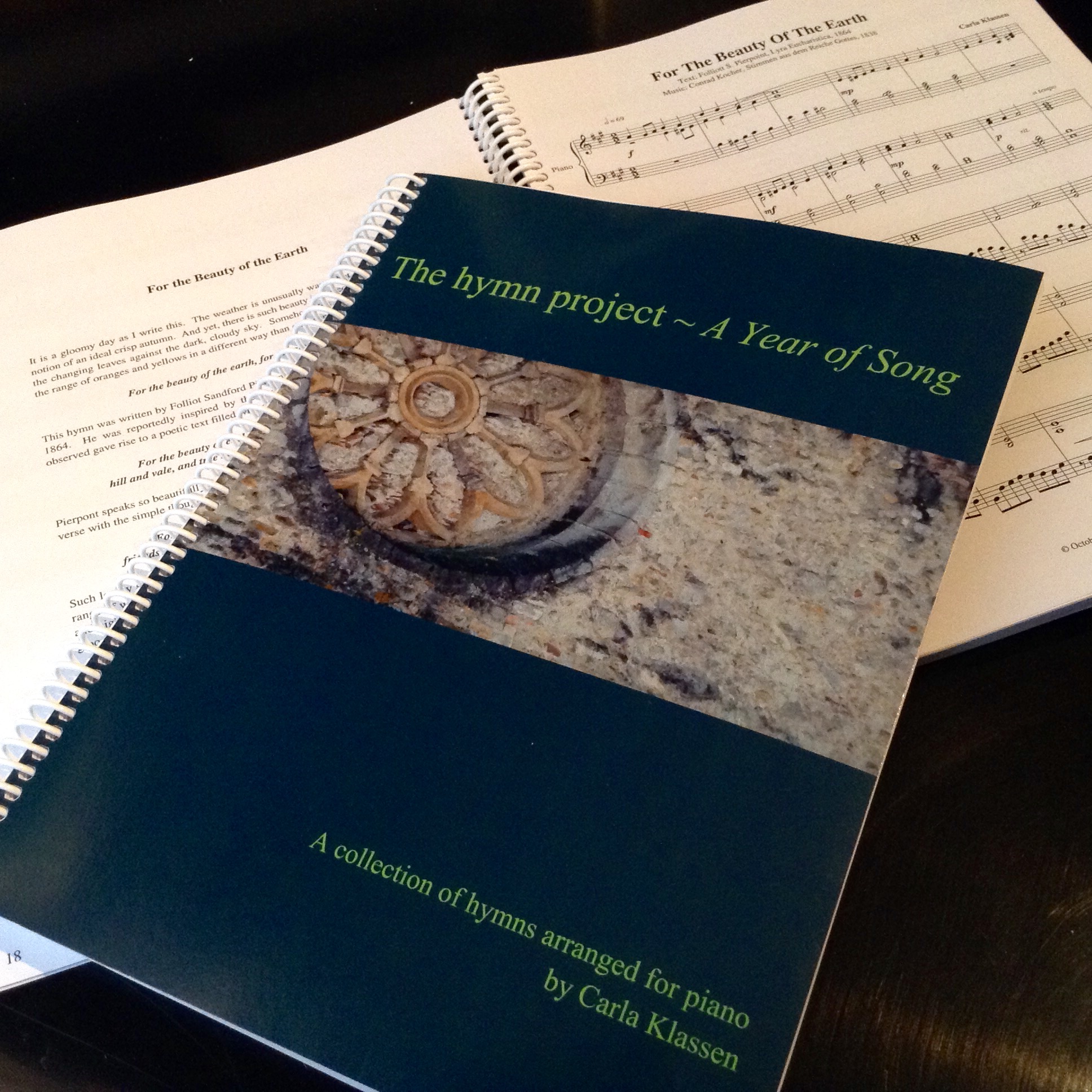
At long last, I have completed the task of compiling all 54 arrangements from this project into a book! Many of you have requested the sheet music for these arrangements over the past year and I am happy to be able to offer it now for those who are interested.
The book contains all 54 arrangements and commentaries. It is coil bound for easy page turning (!) and I’m quite pleased with how they have turned out. The price for each book is $35 plus shipping, if needed ($10 in Canada and $15 to the USA).
To order, go to the ABOUT page at the very top of the screen and fill out the contact form with your request. I will contact you about delivery and payment, which can be made via either e-transfer or cheque.
Thank you all again for your support and encouragement. It has been a truly wonderful experience.
07 Saturday Nov 2015
Posted in Uncategorized
Source: Lord, Let Us Now Depart In Peace
07 Saturday Nov 2015
Posted in Uncategorized
Lord, let us now depart in peace,
who in thy name are gathered here.
Disclose the brightness of thy face,
and be forever near.
Amen
We don’t know who wrote these words. They are simple and, I think, quite beautiful. This is a hymn we sometimes sing at the end of a church service. I often play it as a postlude and find myself having my favourite church experience of hearing the congregation quietly hum along – in four part harmony, of course! The words permeate the music, whether sung aloud or not.
November seems to be the time of year we are asked to remember the sacrifices of those who fought in wars; those who died; those who still suffer in these awful conflicts; those who wish for peace. There are many hymns, anthems, songs and poems that reflect on these thoughts. Some filled with pride, some with sorrow. Many with longing for peace and the end to the horror of war. As I think about what peace means to me, I am struck that in a simplistic way, this small hymn encapsulates an ideal that I treasure. It doesn’t say we need to agree. It doesn’t really have much of an answer. It just says, when we leave each other, let us do it peacefully.
The definition of peace is to be free from disturbance. This applies to the absence of war as much as to the notion of quiet tranquillity. And it applies to our behaviour. To ask for peace means, in part, to provide a space free from disturbance to those we leave. What a challenge. Easy when, as in this hymn, we are gathered with a common focus. Not so easy when we are fighting for what we believe to be right; when we completely disagree; when we know with absolute certainty that the other side is wrong. Yet working for peace requires more than being right. Peace is hard to find and harder to give. But it is worth the effort. To me, it is the brightness found in the face of the Divine. Maybe it’s found in whatever reminds us that there is something greater, and that we are small yet impactful. That we are neither alone nor the centre of the universe. And that we hold the possibility of peace within our hands.
Dona Nobis Pacem
 thehymnproject